
When the Past Becomes the Future
The spiritual power of jazz has always been a social one as well. Today’s jazz draws not only new energy from the growing creative focus on this phenomenon, but also a contemporary relevance. In short: jazz is once again searching for truth—specifically, the kind of truth that can arise only from an open-ended form. “ Enjoy jazz ” presents outstanding representatives of this high art: Tomoki Sanders, Sullivan Fortner, Lakecia Benjamin, and James Brandon Lewis.
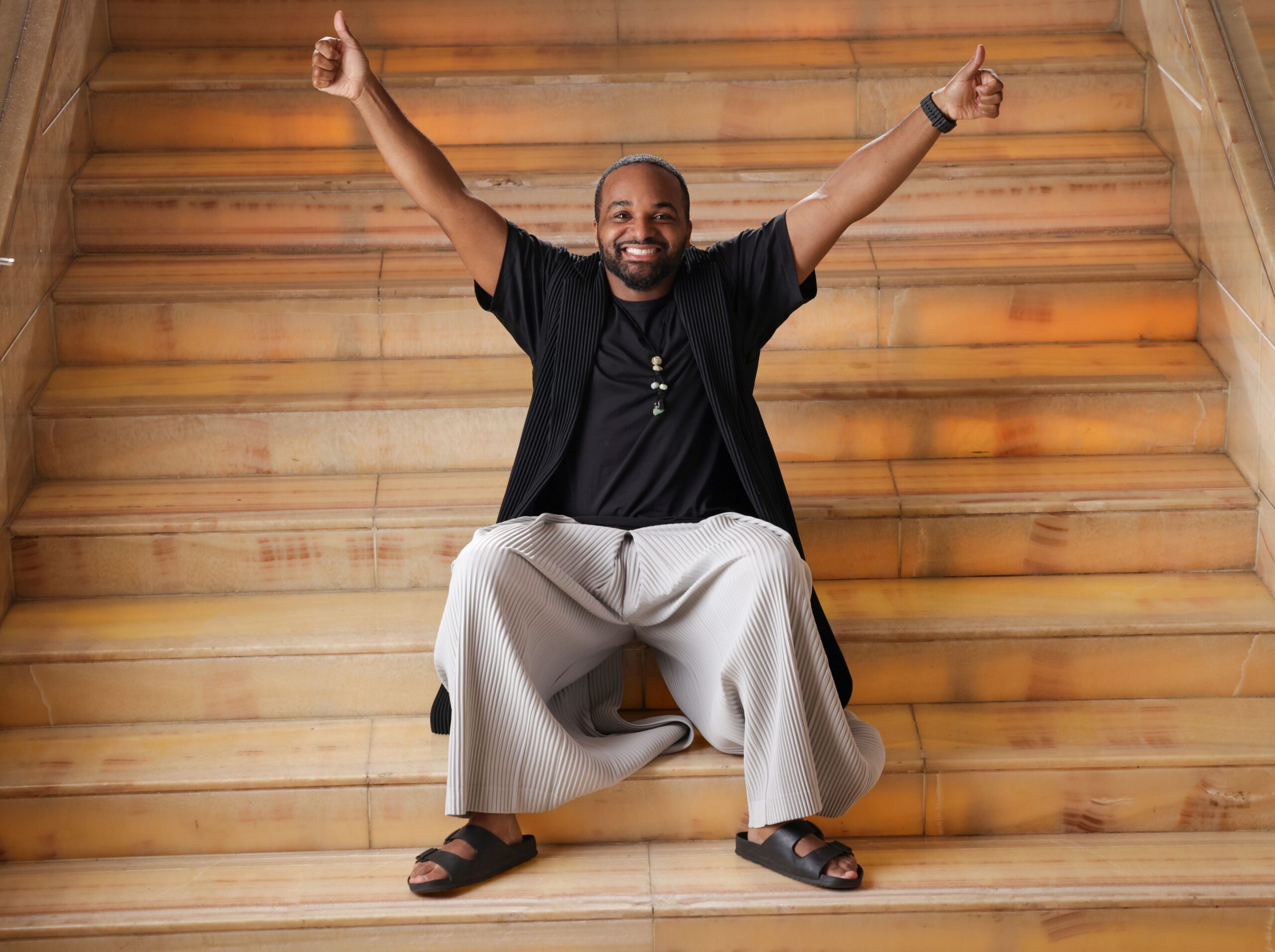
New York saxophonist Tomoki Sanders doesn’t play concerts—he celebrates musical high masses. Within moments, he expands his drawn-out melodic lines—which meander forward with great freedom—into multidimensional soundscapes. They are characterized by the same otherworldly, cave-like labyrinths of deceleration found in the spiritual jazz of the 1960s. The non-binary musician’s performances are meditations on liberation from the confines of a liminal world: “It took me five or six years to realize that I have a different energy that existed outside the entire cis-male ideology. I found myself somewhere in between.” And yes, Tomoki is the son of the great Pharaoh Sanders. “I’m very grateful that I had what I consider to be the coolest dad in the world.” What he learned from him is “to remain true to every single impulse in my head, my soul, and my spirit—simply to remain true to the music and serve it.” As for Lakecia Benjamin’s connections to spiritual jazz, nothing more needs to be said since her tribute album to Alice and John Coltrane. To describe her concert power, a single sentence sufficed anyway: “A rousing performance that makes the paint peel off the walls” (All About Jazz). This saxophonist is like a high-energy battery that constantly recharges itself while playing, spraying a shower of creative sparks into the hall. Musician and activist Terri Lyne Carrington praises Benjamin’s attitude as “combative.” According to John Scofield, she’s “always had her foot fully on the gas pedal.” These are the qualities that make Lakecia Benjamin the saxophonist of the moment. Piano rising star Sullivan Fortner recently commented in an interview with “Jazz Weekly” on his own spiritually driven motivation as a musician: “No matter how much or how little it pays, you don’t do it for the money, but as a service—as a service to God and to people; it is a spiritual calling.” The three-time Grammy winner commands the utmost respect even among piano legends. Jason Moran calls him “a spiritually grounded soul” who uses every means at his disposal “to create a force field.” And for Fred Hersch, he is simply “one of the best pianists in the world.”
For Fortner is not only a marvel of rhythmic precision—which has earned him, among other things, a role as a collaborator with the two most important jazz singers of the younger generation: Cécile McLorin Salvant and Samara Joy. He is also a bridge between the jazz tradition associated with the Ellis Marsalis School and its evolution through Latin influences and a finely balanced lyricism. His playing is complex yet imbued with immense sensuality. He consistently delivers his mastery at the highest level. Perhaps this is also because he doesn’t sit alone at the piano, as he recently admitted: “I just play, and I leave the rest to God.” James Brandon Lewis needs no introduction to the Enjoy Jazz audience. At no other sold-out concert during the last festival was the demand greater. In 2026, he’ll be returning with the all-star band The Messthetics. And yet the saxophonist could actually have retired by now. After all, he’s unlikely to receive a greater compliment than the one from the great style icon Sonny Rollins: “When I listen to you, I hear Buddha … the deeper meaning of life.” Lewis, for whom jazz is a “spiritual practice,” is considered the most technically accomplished saxophonist of his generation. His playing is powerful, at times even raw. He views the familiar as a stepping stone to the new. Tradition, he explains, “is not something you copy. It’s something you carry forward.” In doing so, his own spirituality is a commitment. Or as he puts it himself: “Every note should carry intention and soul.”
Photography by John Abbott
www.johnabbottphoto.com
©John Abbott
Date: 18. September 2026
Latest posts
More articles in the category: magazine
I hear something you can't see
Enjoy Jazz Featuring World-Class Female Singers In 2017, Michael W. Kraus, a professor of psychology at Yale University, made an interesting observation: when we listen exclusively to the person we’re talking to—that is, without seeing or touching them—we can ...
100 Years After Coltrane – Born to Last
John Coltrane is among those who paved the way for spiritual jazz as both a musical practice and a spiritual attitude. However, the spiritual power of jazz sometimes also lies in its ability to go far beyond ...
"Beauty isn't necessarily beautiful."
The founder and artistic director of Enjoy Jazz has chosen “Beauty” as the theme for his “Festival for Jazz and More” for the fourth year in a row. We spoke with him about how this theme relates to the ...